
Insulating oil serves two vital purposes inside high-voltage electrical equipment: heat dissipation and electrical insulation. Over time, moisture, cellulose fibers, conductive particles, and oxidation byproducts degrade this insulation performance. Dielectric Breakdown Voltage (BDV) testing is the fastest, most critical diagnostic method to evaluate whether transformer oil can safely withstand electrical stress without arcing.
However, a breakdown voltage value in kilovolts (kV) is meaningless unless it is tied to a specific oil breakdown voltage standard. Testing the exact same oil sample under ASTM D1816, ASTM D877, and IEC 60156 will yield drastically different results due to variations in electric field geometry, oil circulation, and voltage ramp rates.
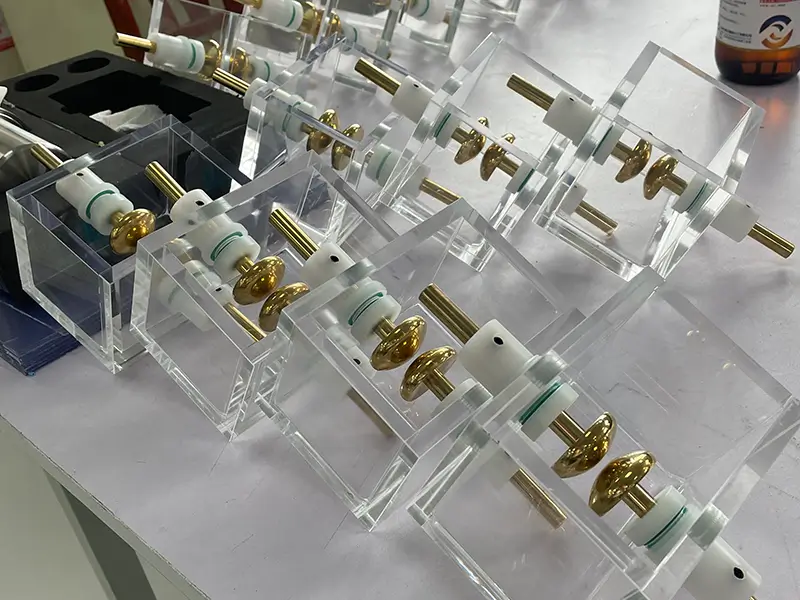
- ASTM D1816 uses VDE (mushroom/spherical-capped) electrodes, continuous stirring, and a slow 0.5 kV/s voltage rise rate. It is highly sensitive to dissolved moisture and fibrous contaminants, making it ideal for modern high-voltage power transformers in North America.
- ASTM D877 uses flat-faced disk electrodes, no stirring, and a fast 3.0 kV/s rise rate. Because it is less sensitive to moisture and suspended particles, it is primarily used for new/unfiltered oil deliveries, legacy apparatus, and high-viscosity insulating liquids.
- IEC 60156 is the dominant international standard outside North America. It uses spherical or VDE mushroom electrodes with a 2.5 mm gap, gentle stirring, and a moderate 2.0 kV/s voltage rise rate.
In this comprehensive guide, we break down the technical differences in ASTM D1816 vs ASTM D877 and IEC 60156 oil testing, and help your laboratory select the right methodology and testing equipment.
Side-by-Side Comparison: ASTM D1816 vs. ASTM D877 vs. IEC 60156
For engineers and laboratory managers looking for an immediate technical reference, the table below summarizes the core parameters of each oil breakdown voltage standard:
| Test Parameter | ASTM D1816 | ASTM D877 | IEC 60156 (2018) |
| Electrode Shape | VDE (Spherical-capped / Mushroom) | Flat Cylindrical Disk (Sharp edges) | Spherical or VDE (Mushroom) |
| Electrode Gap | 1.0 mm or 2.0 mm | 2.54 mm (0.10 in.) | 2.50 mm |
| Voltage Boosting Rate | 0.5 kV/s | 3.0 kV/s | 2.0 kV/s |
| Stirring Method | Continuous gentle stirring | Static (No stirring) | Gentle stirring (Continuous or between shots) |
| Initial Standing Time | 3 – 5 minutes | 2 – 3 minutes | 2 minutes (minimum) |
| Number of Breakdowns | 5 breakdowns per fill | 5 breakdowns (1 or 5 cups depending on Procedure A/B) | 6 breakdowns per fill |
| Sensitivity to Moisture & Fibers | Very High | Low | High |
| Primary Geographic Region | North America & IEEE regions | North America (Legacy / Bulk oil) | Global (Europe, Asia, Middle East, Africa, LATAM) |
Deep Dive: The 3 Core Technical Differences
Why do these three standards behave so differently in the lab? The answer lies in physics—specifically how impurities interact with the electric field inside the oil cup.
1. Electrode Shapes: Uniform vs. Non-Uniform Electric Fields
The geometry of the brass or stainless-steel electrodes dictates the uniformity of the electric field across the oil gap.
- Flat Disk Electrodes (ASTM D877): ASTM D877 uses 25.4 mm diameter flat-faced cylindrical disks with sharp 90-degree edges. In high-voltage physics, sharp edges concentrate electrical stress. As a result, ASTM D877 creates a non-uniform electric field along the perimeter of the disks. Breakdown almost always initiates at the sharp edges rather than across the main volume of oil, meaning dispersed moisture and cellulose fibers in the middle of the cup often go undetected.
- VDE / Spherical-Capped Electrodes (ASTM D1816 & IEC 60156): Both ASTM D1816 and IEC 60156 oil testing utilize smooth, curved VDE (Verband Deutscher Elektrotechniker) “mushroom” or spherical electrodes. This contoured profile eliminates edge effects and generates a highly uniform electric field over a large surface area. Any microscopic water droplet or wet cellulose fiber passing through this uniform zone will trigger an immediate breakdown, accurately reflecting the true condition of an energized transformer winding.
2. Stirring Methods: Static vs. Dynamic Oil Circulation
Transformer oil inside an operating power transformer is rarely static—it circulates continuously via thermal convection or forced oil pumps.
- No Stirring (ASTM D877): The oil remains completely motionless during the test. Heavy particles settle to the bottom of the test cell before the voltage reaches critical levels. Furthermore, after an arc occurs, carbonized byproducts can linger near the gap or float upward, skewing subsequent readings if not properly rested.
- Continuous Stirring (ASTM D1816): An impeller or magnetic stirrer circulates the oil continuously throughout the entire test sequence (taking care not to introduce air bubbles). This keeps cellulose fibers and free water suspended, sweeping them directly into the high-stress electrode gap.
- Controlled / Gentle Stirring (IEC 60156): IEC 60156:2018 specifies gentle circulation using a magnetic stirrer or impeller to disperse carbon particles produced by previous breakdowns and ensure sample homogeneity without creating micro-bubbles, which would prematurely lower BDV readings.
3. Voltage Boosting Rates: Time Under Electrical Stress
Dielectric breakdown in liquid insulation is not purely instantaneous; contaminants need time to polarize, align, and form a conductive “bridge” between the electrodes.
- Slow Ramp – 0.5 kV/s (ASTM D1816): Rising at just 500 volts per second gives polar molecules (water) and wet fibers ample time to get pulled into the strongest part of the electric field and line up into a breakdown bridge. Consequently, ASTM D1816 produces lower, more conservative—and far more diagnostic—BDV numbers.
- Moderate Ramp – 2.0 kV/s (IEC 60156): Strikes an optimal balance between laboratory testing efficiency and diagnostic sensitivity to moisture and particulates. At a 2.5 mm gap, high-grade in-service mineral oil typically achieves breakdown values above 50 kV to 70 kV+.
- Fast Ramp – 3.0 kV/s (ASTM D877): Because the voltage climbs six times faster than in ASTM D1816, dispersed impurities simply do not have enough time to migrate and bridge the 2.54 mm gap before the oil itself reaches intrinsic breakdown at the sharp disk edges.
How Should Your Laboratory Choose the Right Oil Breakdown Voltage Standard?
Selecting the wrong test standard can lead to false confidence in degraded oil—or unnecessary oil reclamation expenses. Use the following criteria to guide your lab’s SOP:
- Check Regional Grid & Regulatory Mandates:
- If your facility operates under IEC, EN, BS, or DL/T guidelines (common across Europe, Asia, the Middle East, Africa, and South America), IEC 60156 is your mandatory benchmark.
- If your facility follows IEEE C57.106 (North America and select utilities globally), choose between ASTM D1816 and ASTM D877 based on equipment class.
- Match the Standard to Equipment Voltage & Oil Type (ASTM Users):
- Choose ASTM D1816 for all filtered oils, in-service power transformers (especially ≥ 69 kV and EHV units), and any equipment containing paper/cellulose insulation where moisture-fiber synergy is a failure risk. Note: Use a 1.0 mm gap if breakdown exceeds the upper limit of your 60–80 kV tester at a 2.0 mm gap, or follow your utility’s historical baseline.
- Choose ASTM D877 when testing bulk, unfiltered new oil deliveries in tankers/drums prior to vacuum dehydration, legacy low-voltage switchgear/circuit breakers, or high-viscosity insulating fluids (such as silicone fluids or high-molecular-weight hydrocarbons) that trap air bubbles if stirred under D1816.
- Maintain Historical Trend Consistency:
- Never compare a historical ASTM D877 result (e.g., 42 kV) directly with a new ASTM D1816 (2 mm gap) or IEC 60156 result. Always keep gap distance, electrode type, and standard consistent when trending asset health over years.
Bridging Global Standards with One Instrument: The ZWJD111E (80kV) Solution
For commercial oil testing laboratories, transformer manufacturers, and utility maintenance teams servicing international equipment, buying separate testers for IEC and ASTM standards is cost-prohibitive. What your lab needs is a precision microprocessor-controlled BDV tester capable of adapting its voltage ramp rate, stirring logic, and timing intervals on demand.
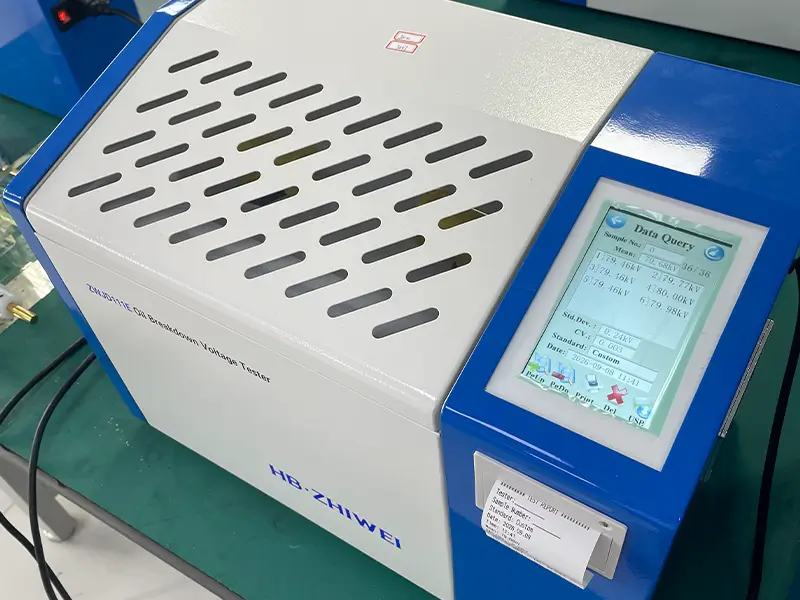
The ZWJD111E Transformer Oil BDV Tester (manufactured by Baoding Zhiwei Electric Power Technology Co., Limited) is engineered specifically to meet IEC 60156:2018 out of the box while offering a flexible Custom Mode that seamlessly accommodates ASTM D1816 and ASTM D877 test profiles when paired with the appropriate oil cup and electrodes.
Why Laboratories Choose the ZWJD111E Transformer Oil BDV Tester:
- Wide Output Range & High Precision: Delivers a smooth, even 0–80 kV output (with a 1.5 kVA booster capacity), measuring accuracy, and a voltage distortion rate of —ensuring clean sinusoidal AC waveforms at both 50 Hz and 60 Hz.
- Fully Programmable Voltage Boosting Rate: Under Custom Mode, operators can set the voltage rise rate anywhere from 0.5 kV/s to 5.0 kV/s. Whether you need 0.5 kV/s (ASTM D1816), 2.0 kV/s (IEC 60156), or 3.0 kV/s (ASTM D877), the single-chip microcomputer maintains rock-solid speed stability.
- Flexible Stirring & Rest Control: Easily configure stirring time from 0–120 seconds (set to
0sfor static ASTM D877 tests, timed intervals for IEC 60156, orCONT[Continuous] for ASTM D1816). Standing time (0–15 min), boosting intervals (0–5 min), and breakdown cycles (1–10 shots) are all user-definable via the large English LCD interface. - Streamlined Lab Data Management: Automatically calculates average BDV values, stores up to 100 test groups with power-down memory protection, prints instant hardcopies via the built-in thermal printer, and supports fast data export via USB flash drive and RS232 PC interface.
- Built for Lab & Field Safety: Compact and portable (460 × 280 × 320 mm), featuring comprehensive over-voltage, over-current, and high-voltage lid interlock limit protections to keep operators safe.
Pro Tip for Lab Technicians: Oil Cup Care Matters
Even the most accurate 80 kV tester will produce erratic numbers if the oil cup is contaminated. Always adjust your electrode gap with a precision go/no-go gauge before testing, clean the cup and agitating blades using petroleum ether (never touch blades with bare fingers), rinse 1–3 times with the target oil sample, and store idle cups completely filled with clean, dry transformer oil to prevent atmospheric moisture absorption.
Frequently Asked Questions (FAQ)
Q1: Can you convert ASTM D877 results to ASTM D1816 or IEC 60156?
No. There is no valid mathematical formula or conversion factor between ASTM D877, ASTM D1816, and IEC 60156. Because each standard reacts differently to dissolved water, solid particles, and oil flow, an oil sample with high moisture might pass ASTM D877 at 35 kV yet fail ASTM D1816 at 18 kV.
Q2: Why is IEC 60156 the most widely used oil testing standard globally?
IEC 60156 provides an ideal combination of diagnostic reliability and operational speed. Its 2.5 mm gap with VDE/spherical electrodes creates a uniform electric field capable of detecting dangerous moisture and fiber contamination, while its 2.0 kV/s ramp rate allows 6 consecutive breakdowns to be completed quickly with high repeatability.
Q3: What is an acceptable breakdown voltage for transformer oil?
Acceptable limits depend on the standard and transformer voltage class:
- Under IEC 60156 (2.5 mm gap), newly treated oil injected into high-voltage transformers typically requires , while in-service oil generally requires to 50 kV (for systems ).
- Under ASTM D1816 (2.0 mm gap), new oil in high-voltage equipment typically requires to , while in-service oil minimums range from to per IEEE C57.106.
Q4: Is an 80 kV BDV tester sufficient for modern insulating oil testing?
Yes. For routine laboratory and field diagnostics under IEC 60156, ASTM D1816, and ASTM D877, an 0–80 kV tester like the ZWJD111E easily exceeds the minimum acceptance thresholds (which typically fall between 30 kV and 70 kV) for mineral, natural ester, and synthetic ester insulating oils, while keeping the unit lightweight and portable.
Upgrade Your Insulating Oil Testing Capabilities Today
Looking for a reliable, multi-standard Transformer Oil BDV Tester with customizable electrode oil cups for IEC 60156, ASTM D1816, and ASTM D877?
Contact us today for factory-direct pricing, electrode customization options, and technical support on the ZWJD111E (80kV) Insulation Oil Dielectric Strength Tester.
- Website: www.oilhvtester.com
- Email: sales003@zhiweielectric.com
- WhatsApp / Phone: +86 13833237336